By Kheloexch Sports Desk
A yellow card in football is a caution, while a red card sends a player off the pitch for the rest of the match. That is the short answer. But the long one, the one that actually helps you understand what you just watched, lives in Law 12 of the IFAB Laws of the Game, and it covers a lot more than most fans realise.
The 2026/27 Laws took effect on 1 July 2026 and brought several card changes, from VAR reviews of second yellows to new sending-off offences that competitions can choose to adopt.
What Is the Difference Between a Yellow and Red Card?
One card keeps a player on the pitch; the other ends their match.
| Card | What it means | What happens | Common triggers |
| Yellow | Caution | Player stays on | Dissent, time-wasting, unsporting behaviour |
| Red | Sending-off | Player leaves, cannot return | Violent conduct, serious foul play, spitting, second yellow |
A red card drops the team to 10 players. The match continues with fewer players. Under Law 3, a match cannot continue if a team has fewer than seven players; the competition’s rules then decide the result.
Yellow Card Rules in Football
Getting a yellow card does not end your match. It is a warning, logged by the referee, and the player stays on the pitch and carries on.
Common Yellow Card Offences
Under Law 12, the situations that earn a caution include:
- Dissent, whether verbal or physical
- Deliberately delaying a restart, including (since 2026/27) taking too long to leave the pitch when substituted
- Stepping on or off the pitch without the referee’s permission
- Persistent rule-breaking across the match
- Unsporting behaviour
- Refusing to respect the required distance at a free kick or corner
What Happens After a Yellow Card?
Play continues and the player stays. The only consequence with immediate weight is what happens if that same player gets cautioned again. A second yellow in the same match means a red card and a dismissal, with no exceptions.
Red Card Rules in Football
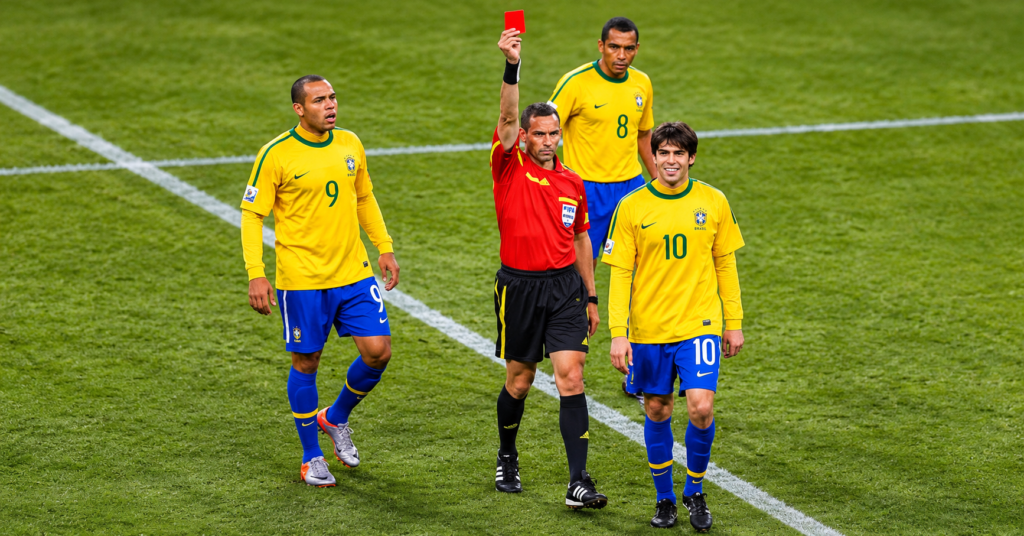
A red card is a sending-off. The player walks to the dressing room. No substitute replaces them. The team finishes the match one short.
Common Red Card Offences
Law 12 lists the offences that result in a sending-off:
- Serious foul play
- Violent conduct
- Biting or spitting at anyone
- Offensive, abusive or insulting language or gestures
- Denying an obvious goal-scoring opportunity through a handball
- Denying an obvious goal-scoring opportunity through a foul
- Receiving a second caution in the same match
- Entering the video operation room
The 2026/27 Laws also let competitions add two new sending-off offences: covering the mouth when speaking to an opponent in a provocative or insulting way, and leaving the pitch in protest at a referee’s decision. These apply only where a competition adopts them.
What Is DOGSO in Football?
DOGSO stands for “Denying an Obvious Goal-Scoring Opportunity.” If a defender fouls an attacker who was clean through on goal, the referee can send them off for DOGSO. Inside the penalty area, a defender who made a genuine attempt to play the ball is cautioned instead, because the penalty already restores the chance. The 2026/27 update brought one notable change: if the referee plays advantage and a goal is then scored, no caution is given for the original DOGSO offence.
Two Yellow Cards: How the Rule Works
The sequence is straightforward, but fans still debate whether referees apply it consistently.
- First cautionable offence: yellow card
- Second cautionable offence in the same match: second yellow card
- Referee shows a red card immediately after the second yellow
- Player is dismissed
- Team finishes with 10 players
A second yellow can change the whole shape of a match. With one fewer player, the manager may ask a defender to drop deeper or push a midfielder into covering more ground. Those decisions depend on the roles in the system, which our guide to football positions explained covers in detail.
Can Managers Receive Yellow and Red Cards?
Yes, and this surprises a lot of supporters the first time it happens.
Team officials in the technical area — managers, assistant coaches, medical staff — are all subject to Law 12. If a team official behaves in a way that earns a card and cannot be identified, the referee shows it to the most senior coach present in the technical area.
There is a reasonable debate here. Some supporters feel managers get too many cards for ordinary touchline emotion, that they are being punished for caring too visibly. Others argue that clear boundaries protect match officials and players, and that the rules should apply uniformly. Both views have logic behind them.
Do Yellow Cards Lead to Suspensions?
They can, but the trigger depends entirely on the competition.
The Laws of the Game set what happens on the pitch: a caution, a dismissal, a reduced team. Leagues and cups write their own accumulation rules. So the number of yellows that leads to a ban differs across competitions.
The Premier League is a useful example. Under the FA’s disciplinary rules, a player who collects five yellow cards in their club’s first 19 league matches serves a one-match ban, and a player who reaches 10 yellow cards by their club’s 32nd league match serves a two-match ban. These thresholds apply only to that competition, not to football as a whole.
Red cards work differently in English football: a ban for a sending-off covers all competitive matches, while yellow-card bans stay within the competition where the cards were shown.
When VAR Reviews a Red Card
VAR does not check every card shown in a match. Its scope on card decisions is narrower than most fans assume.
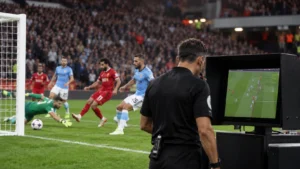
VAR can review direct red-card decisions, such as violent conduct, serious foul play or DOGSO, when the on-field call is clearly wrong. Since the 2026/27 Laws, VAR can also review a red card that resulted from a clearly incorrect second yellow.
Ordinary yellow cards are not reviewed. There are two exceptions: VAR can step in if a yellow was shown for what was really a red-card offence, and, since 2026/27, it can correct mistaken identity when a card is shown to the wrong player.
Frequently Asked Questions
What is a yellow card in football?
A yellow card is a caution. The player stays on the pitch, but a second yellow in the same match brings a red card.
What is a red card in football?
A red card is a sending-off. The player must leave the pitch and cannot be replaced, so the team plays on with one player fewer.
What is a green card in football?
There is no green card in the Laws of the Game. A few competitions have used one to reward fair play, such as Italy’s Serie B from 2016.
What is a blue card in football?
Elite football has no blue card. The Laws let national associations use temporary dismissals (sin bins) for cautions in their own competitions, mostly at grassroots level, and some show a blue card for them.
Who invented yellow and red cards?
English referee Ken Aston came up with the idea, and the cards were first used at the 1970 FIFA World Cup in Mexico. For the wider story of the game, read who invented football.
Do yellow cards carry over between competitions?
No. Yellow-card totals usually count only within the competition where they were shown, and each competition sets its own suspension thresholds.
Why Cards Change Matches
Cards shape matches as much as goals do. A second yellow at the right moment can flip a game’s power balance completely. A red card can turn a controlled contest into 20 minutes of defending for survival.
Read more football guides and news, or head back to KheloExch Sports.
The rules in this guide follow IFAB’s 2026/27 Laws of the Game, with suspension rules from the FA and the Premier League.
Sources:
- IFAB — Law 12: Fouls and Misconduct
- The FA — Law 12: Fouls and Misconduct
- IFAB — Changes to the Laws of the Game 2026/27
- Premier League — Yellow card suspension rules
Disclaimer: This article is for general information only.