
By Kheloexch Sports Desk
The standard football match duration is 90 minutes, played as two 45-minute halves. The referee adds time at the end of each half for stoppages, so a match almost always runs longer than 90 minutes on the clock.
In knockout games, extra time and a penalty shoot-out can push the total past two hours. So how long is a football match in practice? It depends on stoppages, referee decisions and the rules of the competition.
The Basic Football Match Duration
Under IFAB’s Law 7, a match consists of two equal halves of 45 minutes. The halves can only be shortened if the referee and both teams agree before kick-off and the competition’s rules allow it.
Players are entitled to a half-time interval of no more than 15 minutes. Competition rules set its exact length, and it can only be changed with the referee’s permission.
| Part of the match | Official duration |
| First half | 45 minutes |
| Half time break | Maximum 15 minutes |
| Second half | 45 minutes |
| Total regulation time | 90 minutes |
Why Referees Add Stoppage Time
The match clock keeps running when play stops. To make up for lost time, the referee adds minutes at the end of each half. This is called stoppage time, added time or injury time.
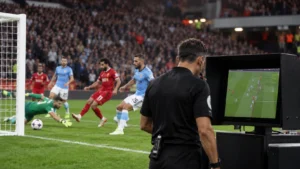
Law 7 lists the causes: substitutions, assessing and removing injured players, time-wasting, disciplinary sanctions, permitted drinks or cooling breaks, VAR checks and reviews, goal celebrations and any other significant delay to a restart.
At the end of each half, the fourth official holds up a board showing the minimum added time. The referee can add more if play stops again, but under Law 7 the added time can be increased, never reduced.
The 2026/27 Laws also target time-wasting. A player who takes too long to leave the pitch when substituted can now be cautioned, and a goalkeeper who holds the ball for more than eight seconds concedes a corner to the other team.
| Interruption | Why it extends the half |
| Substitutions | Players walking on and off take time |
| Injuries | Medical staff treating players on the pitch |
| VAR reviews | Video checks pausing momentum |
| Celebrations | Prolonged group cheers after a goal |
| Time wasting | Intentional delays during goal kicks or throw ins |
What Happens When Scores Are Level?
League matches can end in a draw after 90 minutes plus stoppage time. Knockout matches need a winner, so in most competitions the teams play extra time: two periods of up to 15 minutes each, with a short break between them.
If the scores are still level after extra time, the match goes to penalties. Each team takes five kicks, alternating, and the shoot-out ends early if one team can no longer catch up. If they are still level after five kicks each, it continues in sudden-death pairs until one team scores and the other misses. Shoot-out goals do not count towards the match score.
Match Lengths Across Different Competitions
In practice, the format of the competition changes how long a match lasts:
- League games: Played over two 45-minute halves plus stoppage time, where a draw is a valid final result.
- Knockout rounds: Standard 90 minutes, followed by extra time and penalties if the scores are level (or the aggregate score in a two-legged tie).
- Domestic cups: Some tournaments skip extra time entirely, heading straight to penalties once regulation time expires. England’s EFL Cup, for example, goes straight to penalties in every round except the final.
- Youth fixtures: Often feature shorter halves adjusted for age groups, reducing the overall match length.
Total Screen Time for Television Viewers
On TV, a match broadcast usually runs about two hours once pre-match analysis, half-time coverage and stoppage time are included. Extra time and penalties can push it towards two and a half hours.
Frequently Asked Questions
How long is half time in football?
No more than 15 minutes under Law 7. Each competition sets the exact length, and most top competitions use the full 15 minutes.
What is injury time in football?
Injury time is another name for stoppage time or added time: the minutes the referee adds at the end of each half for time lost to injuries, substitutions, VAR checks and other delays.
How long is extra time in football?
Extra time is two periods of up to 15 minutes each, so 30 minutes in total, plus any stoppage time and a short break between the two periods.
What happens if a penalty shoot-out is level after five kicks?
It goes to sudden death. Each team takes one kick at a time until one team scores and the other misses.
Does stoppage time count as part of the 90 minutes?
No. Stoppage time is added on top of each 45-minute half, which is why you see times such as 45+3 or 90+5.
Why the Final Whistle Is Hard to Predict
A late equaliser, a long VAR review or a shoot-out that goes to sudden death can turn a routine 90 minutes into a much longer match. The 90 minutes are only the starting point.
For more rules explained simply, read our guides to VAR in football and yellow and red card rules, or browse more football guides and news on KheloExch Sports.
Disclaimer: This article is for general information only.
The rules in this guide follow IFAB’s Laws of the Game, mainly Law 7 (duration of the match) and Law 10 (determining the outcome).
Sources: