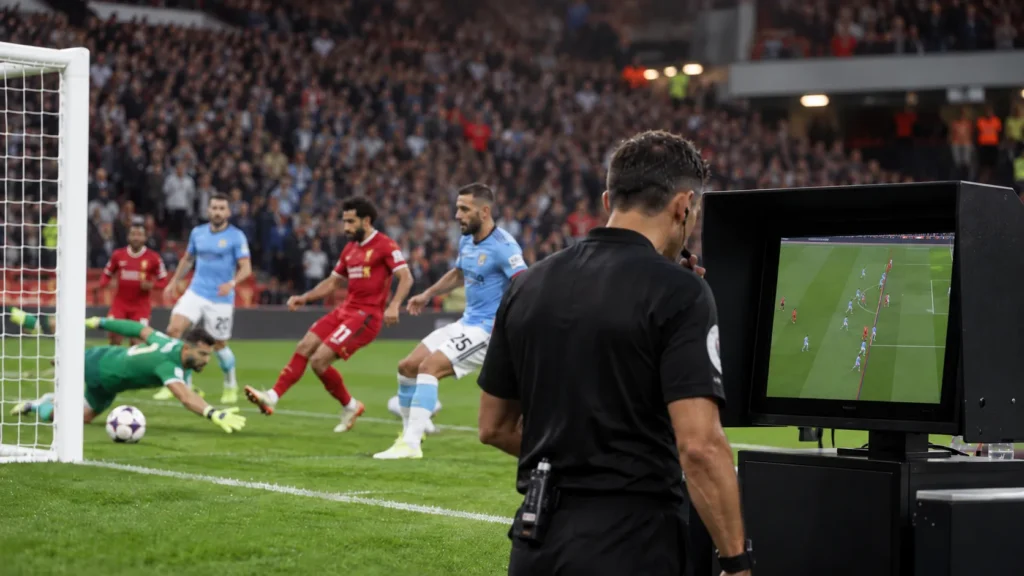
It’s the 89th minute. Your club needs a goal. The ball gets floated over the top, your striker beats the offside trap, taps it past the keeper, and the ball hits the back of the net.
You jump off the couch, screaming. Total chaos in the living room.
Then you look at the screen. The striker isn’t celebrating anymore. He’s looking over at the linesman. The referee is standing near the center circle with a hand held up to his earpiece, listening to someone.
Four words flash across the broadcast screen: VAR check in progress.
Everything comes to a standstill. All the excitement is literally sucked out of the room. Half the crowd in the stadium begin biting on their fingernails while the other half looks up at the giant screen, hoping that the goal counts. This is the very moment of tense anticipation that modern day football brings.
What Does the Term ‘VAR’ Stand For?
If you are asking about the VAR full form, it stands for Video Assistant Referee.
Most people use “VAR” to talk about the screen on the sideline or the whole review process itself. But technically, the term refers to an actual person. It’s a qualified referee sitting in a control room, watching live camera angles to help out the referee running around on the grass.
When football introduced video checks back in 2018, the official pitch was to fix “clear and obvious errors” without stopping the game every two minutes. Whether it actually worked out that way depends on who you ask after a match.
VAR Full Form in Football: Quick Answer
- VAR Full Form: Video Assistant Referee
- What it does: Uses stadium camera replays to help the main referee fix big mistakes.
- When it applies: Goals, penalties, straight red cards, and mistaken identity.
- Who makes the final call? The referee on the pitch always gets the last word.
- Is it Goal Line Tech? No. Goal line technology is automated and instant; VAR involves human video reviews.
Why Football Ended Up Using Video Replays
Referees have an almost impossible job. Play moves insanely fast, players dive, and officials only get one angle in real time while millions of people watching on TV get ten slow-motion replays from five different cameras.
Remember those infamous matches where a player punched the ball into the net or an assistant referee flagged a striker offside when he was two yards onside? Unexpected errors like those ruined major tournaments and wiped out millions in club revenues.
To shield officials from ruthless press headlines and furious fan backlash, governing bodies like IFAB finally introduced video replays.
What Happens Inside the VAR Room?
While you are watching the match, a group of additional referees is sitting in a Video Operation Room (VOR), which usually is located miles away from the stadium in the central broadcast station.
The video officials have access to dozens of camera angles, high behind the goal views, and slow-motion videos. They watch the match all the time, however, they are not supposed to intervene in the game at any time they want to.
According to the official rules, the VAR team may intervene in the match only in four particular cases:
- Goal and Build-up Play: Offsides, handball or foul play before the goal is scored.
- Penalty Call: Whether the foul play in the penalty area really occurred or it was only a diving.
- Direct Red Card: The referee may check bad tackles, elbowing and fights that happen outside the ball.
- Mistaken Identity: The referee makes sure that he or she booked the correct player if there are two similar looking players in the foul play.
If the video referees would review all throw-ins, corners, or trips, the 90-minute match would be prolonged to 3 hours.
How a Review Works on Matchday
Here is how the whole process plays out when a big incident happens on the pitch:
1. The Play Happens
A goal goes in, someone gets tackled in the penalty box, or a player goes down off the ball.
2. The Silent Check
While players reset, the VAR team quickly reviews the footage in the control room. If they spot a potential error, they tell the referee through the earpiece: “Hold the restart.”
3. The Monitor Review
For factual calls like offsides, the referee just takes the VAR’s word for it. But for subjective calls like how hard a tackle was or whether a handball was intentional, the referee walks over to the pitch-side monitor to look at the footage himself.
4. The Long Wait
Why does it seem to take so long at times? The replay operators have to pause the video to pinpoint the exact millisecond when the ball comes off a player’s foot to draw the offside line. This is because centimeters matter here.
VAR vs Goal Line Technology: What’s the Difference?
A lot of casual viewers mix these two up, but they are totally different systems.
- Goal Line Technology: Completely automated. Uses high-speed cameras around the goal frame to check if the ball crossed the line. If it does, the ref’s watch vibrates with a “GOAL” signal in less than a second. No human review needed.
- Video Assistant Referee: Human-led. Involves officials watching video feeds to judge complex events like fouls, handballs, offsides, and red cards.
Goal Line Tech answers one simple yes-or-no question instantly. VAR deals with complicated rules that require human judgment.
Has VAR Made Football Better or Worse?
It in general depends on who you ask on any given weekend.
On one hand, it gets rid of the most embarrassing refereeing mistakes. Teams don’t lose cup finals anymore because of a goal that was three yards offside. It makes the results fairer on paper.
On the other hand, it kind of ruins the instant excitement of a goal. You score, but instead of celebrating fully, you hold back for a second to make sure no line is getting drawn on a screen. Plus, even with ten slow-motion replays, fans still end up arguing about whether a handball was “natural” or not.
Why the Debate Never Really Ends
People thought technology would eliminate all referee arguments, but football rules aren’t written like math problems. Words like “reckless,” “intent,” or “natural position” mean two people looking at the exact same video angle can still disagree.
At the end of the day, the technology doesn’t make decisions people do. The head referee on the pitch always keeps the final call. VAR can suggest taking another look, but the referee with the whistle makes the ultimate choice.
That’s why years after its arrival, fans are still arguing about decisions on living room sofas, in school hallways, and during live match coverage on Kheloexch long after the final whistle.