
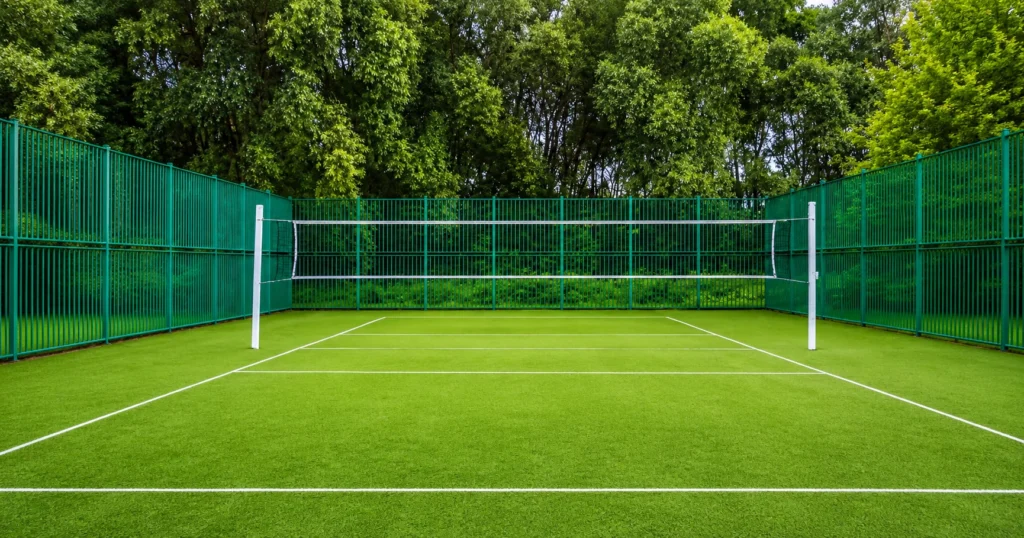
Before you begin, a Badminton Guide for Beginners might assist you in grasping the fundamentals of an outdoor badminton court. A decent court has to have the correct size, a level surface, distinct lines, and safe flooring. But an outdoor setup also has to be extra careful since wind, rain, heat, and dust can influence the game.
Though the court layout might have a major impact, badminton is simple to learn. For instance, a harsh or uneven floor can result in falls. Strong wind might also deflect the path of the shuttle. Planning the court before you build it is thus crucial.
This Badminton Guide for Beginners provides basic care advice on court size, setup, flooring, and simple maintenance. It also clarifies for new players what they require for a more relaxed and safer game. The fundamentals apply whether you design a little practice space or a full court.
Kheloexch offers straightforward event instructions stressing simple learning and clarity of information. Thus, let’s examine the primary components of an outdoor badminton court.
Beginners’ Guide to Badminton: Learn the Proper Court Dimensions
The first thing is to know the proper dimensions of a badminton court. The whole court is given dimensions. Therefore, measuring the area before adding furniture or flooring helps to save time and work.
Doubles call for a 13.4-metre-long by 6.1-metre-wide full court. For singles, the playing width expands to 5.18 metres, and the length stays consistent.
A fundamental court arrangement ought to have:
- An unambiguous playing area
- Appropriate borders
- Sufficient room around the court
- A net set across the middle
- A flat and sturdy platform
- Good lights if you use the court once dark
This section of the Badminton Guide for Beginners is crucial as a proper layout enables players to learn court positioning and movement.
Beginner’s Guide to Badminton: Mark the Court Lines Plainly
Well-defined lines help to simplify the game. You could use outdoor court paint, sturdy tape created for event surfaces, or another acceptable marking technique. But be careful that the marks don’t generate an elevated edge. A line that is raised or loose could be a tripping hazard. Therefore, regularly review the lines and replace any damaged components as necessary.
This is the reason a Badminton Complete Guide should always clarify court size along with lines.
Beginners’ Badminton Guide: Organise Your Outdoor Court the Smart Method
Once you have decided on the site, you can start the arrangement. First, check the ground. The area ought to be as flat as possible. Take out any loose stones, sharp things, and standing water.
Then consider the court’s orientation. The game might be impacted by wind and sunshine. So, check the region before setting up permanently. A straightforward setup procedure could consist of these steps:
- Quantify the entire badminton court space.
- See to it that the ground is level.
- Pick appropriate flooring.
- Indicate the court limits.
- Put the posts firmly.
- Put the net right here.
- Before using it often, check the surface.
Also look for the net tension. A net too slack might hang too low. A very tight net, then again, might stress the posts more. A Badminton Guide for Beginners should emphasise practical and safe steps instead of trying to make the procedure appear difficult.
Beginners’ Badminton Guide: Pick a Safe Location
The proper setting will enhance the gaming experience. Seek an open space free from barriers around the court. At the same time, stay away from areas with a lot of traffic or other dangers.
Trees can shade. But falling branches and leaves can damage the surface. Therefore, frequent cleaning could be necessary. Still another major problem is wind. An outdoor badminton court is less shielded than an indoor court. Even a little wind can propel the shuttle in an unanticipated direction.
Before every class, especially after rain or severe weather, The hub advises inspecting the region.
Beginner’s Badminton Guide: Selecting the Best Outdoor Floor
Among a Badminton Guide for Beginners, flooring is among the most essential components. A bad surface can compromise safety and movement. So pick a surface appropriate for daily foot movement, flat and strong. Many outdoor areas use concrete. It’s robust and simple to keep up. Hard concrete, though, can strain the body during extended sessions.
Another choice is sports tiles. Some outdoor tiles are meant to let water flow through and offer grip. Therefore, under ideal circumstances, they could provide a more pleasant surface. These are some of the popular flooring factors one might want to keep in mind:
- Grip: The surface ought not to be overly slick.
- Drainage: Water ought not to be left on the court.
- Flatness: Uneven spots raise the chance of falling.
- The flooring ought to withstand normal use.
- Cleaning: Pick a surface that is simple to care for.
Your best choice relies on your expected use, budget, and free space. Therefore, before settling on a decision, evaluate the traits.
Beginner’s Guide to Badminton: Maintain floor dryness and cleanliness.
Good flooring also requires routine maintenance. Grip can be compromised by dust, leaves, sand, and water. So sweep the court before use if necessary. Basic maintenance will help the court stay useful over a longer period. Routine inspections can also enable you to spot little issues before they grow more serious. Additionally, supporting the worth of clear sports data and responsible use of playing space is this hub.
Simple Advice for Improved Outdoor Play: Badminton Manual for Newbies
Playing outside, badminton might feel different from playing inside. Therefore, novices may find themselves in need of time to adapt. Strong sunshine can reduce visibility, whereas wind can change shuttle movement. Start with easy shots and basic footwork. Do not only pay attention to ability. Rather, learn to manage the shuttle and cover the court.
Here is some sensible advice:
- Before beginning, check the weather conditions.
- Select shoes with appropriate grip.
- Continue consuming water nearby.
- Before you start playing, warm up.
- Stop if the court becomes insecure.
- Properly store the equipment and netting.
- After usage, tidy the badminton court.
A decent Badminton Guide for Beginners trains players to adapt rather than expect ideal conditions. New players can form better behaviours first by learning the fundamentals, accordingto Kheloexch. Every little action,from footwork to court care—helps to create a more pleasant experience.
Beginner’s Badminton Guide: Create a Court That Enables Safe Play
A well-designed outdoor court can provide novices a good area to work and improve. First, pay attention to the appropriate badminton court dimensions. Then select secure flooring and precisely line-mark. At last, regularly check the court and keep the surrounding area clean.
The optimal arrangement does not always have to be complex. But it should be safe, clear, and steady. One has to pay attention to wind, water, heat, and surface wear.
Use a trusted Badminton comprehensive Guide and concentrate on basic information if you wish to learn more about sports foundations, court arrangement, and player advice. While the hub stresses the need for ssimpleand user-centredsports material, Kheloexch seeks to clarify sports data.
Your Next Step Starts Here: Badminton Guide for Beginners
Start with the first move right now. Plan your badminton Court deliberately, evaluate your free space, and examine the ground. Then pick flooring that fits your demands and always keep safety as your top priority.
If necessary, start small. Learn the court plan. Improve your motion. Keep the surface free. First and foremost, relish the learning process one stage at a time.