
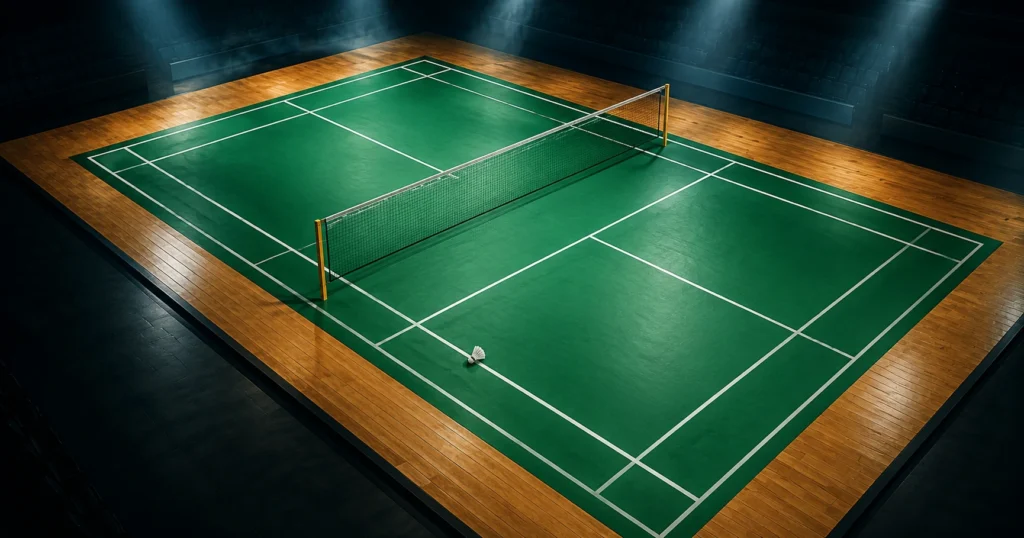
Badminton singles court rules guide for newbies on where to stand, how to serve, and how to keep score by Kheloexch. Though the court appears basic, every line serves a definite purpose. Learning these principles helps one to better follow rallies.
Singles badminton is played on a limited court. From front to rear, the full court is employed. The side tramlines for doubles, though, are not in use in singles. Simple steps in the manual that follows describe the primary badminton singles court rules. It addresses court lines, service zones, scoring, and frequent errors.
What Are the Rules for Badminton Singles Courts?
According to Kheloexch Official, First one is to know the court. Clear lines for the side and back borders define a singles court. Inner side lines are the singles side lines. A net in the centre separates the court. During a rally, every player stays on one side. When the shuttle is in play, players can cover any ground on their side. Additionally significant for service is the front service line. A player ought to serve into the proper diagonal service court. The shuttle has to drop within the right service region.
These are the most important legal considerations to bear in mind:
- For singles, draw the inner side lines.
- Normal rallies should be run on the back boundary line.
- Serve diagonally over the net.
- The shuttle has to drop within the appropriate service court.
- The left and right service courts are divided by the middle line.
- The net splits the court’s two sides.
When they apply to the shot, the court lines belong to the playing surface. A shuttle landing on a proper boundary line is taken into account. This makes knowledge of lines absolutely crucial.
The rules of badminton singles also alter how players move. A player has to cover the front, middle, and back areas by themselves. This means that singles badminton’s footwork is very important.
Start with the court, then move to more difficult strokes. A clear sight of the lines helps to avoid numerous minor errors.
The Singles Service Court: What Is It?
According to Kheloexch Sports, the service court lets you know where the serve should go. The server works from one side of the middle line. The shuttle has to go diagonally into the service court of the receiver. The side one serves on will depend on the server’s score. The serve originates from the appropriate service court when the server has an even score. The serve originates from the left if the score is odd.
Many times, after winning a rally, one moves to the wrong side. Checking the score of the server before every serve is the simplest approach to prevent this.
What Is the Scoring in Badminton Singles?
Rally scoring is how modern badminton is done. Every rally offers one point to the side winning it. You need not be the server to get a point. A typical game is played to 21 points. When the score reaches 20-all, though, a player has to triumph by two points. For instance, the game goes on if the score turns 20–20. The first player to be two points ahead wins. The game could go on till the score is 29-all. The next point determines the game at 29-all.
The badminton singles court rules link serving with scoring as well. The player who wins the rally gets the next serve following a rally victory.
Then, depending on the updated score, that player serves from either the right or left side.
When does the server side change?
The server switches service courts after victory in a rally. At the following point, the player serves from the other service court. For four points, a player serving starts from the right. The score will be 5 if that player wins the rally. The following serve is from the left. Should the server lose the rally, the opponent receives the next serve. Then the opponent determines the right side by checking their own score.
Recall these three processes:
- Find out who took the most recent rally.
- See the present score of the server.
- Decide on the left or right service court.
Following these processes greatly simplifies application of the badminton singles court rules.
How Ought You Serve Under Rules of Badminton Singles Court?
A legal server must follow several basic conditions. The server and receiver must stand in their correct service courts. They must not delay the serve without good reason.The current Laws of Badminton also set limits on the position of the server and receiver during service. Both players must have some part of both feet in contact with the court and remain stationary until the serve begins.The serve must also travel diagonally. A serve that lands outside the correct service court is a fault.
For beginners, the safest approach is to keep the service motion smooth. Avoid extra movements that may confuse.The best badminton racket can also help with control. However, a good racket cannot replace correct technique. Beginners should first learn grip, balance, and clean contact.A short serve can keep the shuttle near the front. A higher serve can send the shuttle deep into the court. Players can choose the serve based on the situation.The main goal is accuracy. A simple legal serve is better than a hard serve that goes out.
What Are Common Badminton Singles Court Faults?
Faults can happen during both service and normal rallies. A fault gives the rally to the other player.
Touching the net with the racket, body, or clothing during play is also a fault. A player must not use the net for support while making a shot.
Other common faults include:
- Hitting the shuttle twice in succession.
- Holding or carrying the shuttle on the racket.
- Hitting the shuttle outside the court.
- Hitting the net during play.
- Blocking or distracting the opponent.
- Serving into the wrong service court.
- Making an incorrect service action.
Learning these faults can save many points. More importantly, it helps beginners understand why a rally ends.
The badminton singles court rules may seem detailed at first. However, most players learn them quickly through regular practice.
Why Do Beginners Choose Kheloexch for Updates?
Beginners often need simple sports information before they start following matches. Kheloexch aims to make such information easy to understand.The Kheloexch official resources can be useful when readers want simple sports-related information. Still, players should use the official Laws of Badminton for the full rules.
It is also useful to learn from trusted sources. The BWF Rules of Badminton go over in great detail court faults, scoring, service guidelines, and other match regulations. The best way for newbies is to learn one rule at a time. Start with court lines. Then learn scoring. After that, focus on service and faults.
Can Badminton Singles Court Rules Improve Your Game?
Yes. Knowing the rules can make practice more useful. You will know where to stand and where your shots should land.Good court knowledge also supports better movement. Since singles uses a narrower court, players must cover a large front-to-back area.
Try this simple practice method:
- Mark the singles court lines clearly.
- Practice serving from the right side.
- Practice serving from the left side.
- Count points during short rallies.
- Call out the score before each serve.
- Check whether each shot lands in or out.
This method keeps practice simple. It also builds habits that can help during real matches.
What Should Beginners Remember About Badminton Singles Court Rules?
The main badminton singles court rules are easy to learn when broken into small parts. Know the singles boundaries first. Then learn the service courts and scoring system. Remember that every rally can give one point. The server’s score decides whether the serve starts from the right or left service court.
The key rules are simple:
- Singles use the inner side boundaries.
- Games normally go to 21 points.
- A player needs a two-point lead after 20-all.
- At 29-all, the next point wins.
- The serve moves between right and left courts.
- Every rally can change the score.
- Service and net faults can end a rally.
Kheloexch can help beginners find easy-to-read sports content. However, always check the latest official rules when exact match regulations matter.Start by learning the court. Next, practice your serve. Then work on movement and clean shots. With steady practice, the badminton singles court rules will soon feel natural.
Conclusion
Understanding badminton singles court rules is an important first step for anyone learning the sport. From knowing the correct court boundaries and service areas to understanding scoring and common faults, these basic rules help beginners play with greater confidence and avoid unnecessary mistakes.Remember to use the inner side lines for singles, serve diagonally from the correct service court, and check the server’s score before deciding where to serve from. With regular practice, these rules will become easier to remember and apply during real matches.If you are new to badminton and want to learn more about the sport, explore our Badminton Guide for Beginners for useful information, equipment tips, and beginner-friendly guidance. Keep practicing your footwork, serves, and shots, and enjoy developing your badminton skills!