
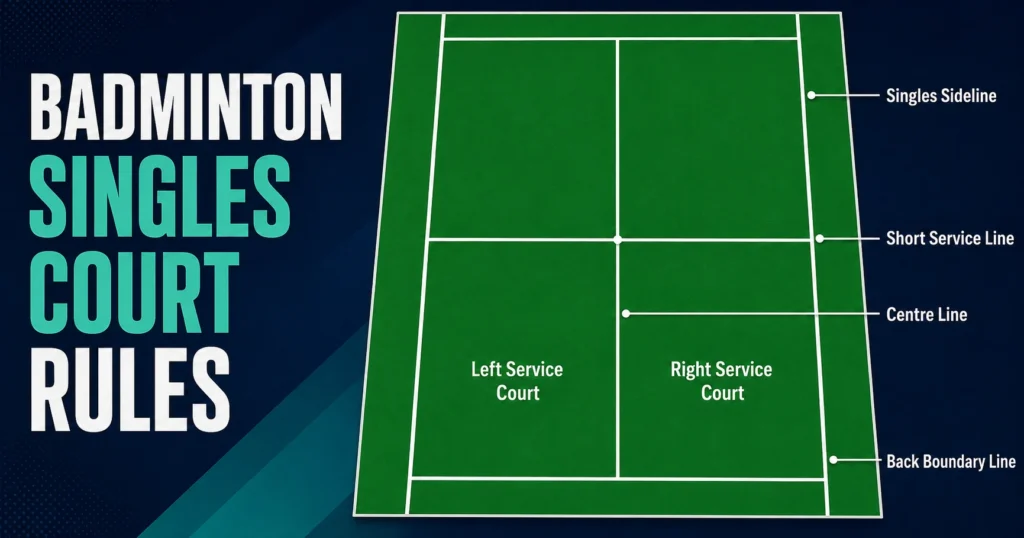
For beginners, the Badminton Guide shows how to learn the court, keep score, serve correctly, and stay clear of frequent mistakes. At first glance, singles badminton seems easy. However, understanding a few basic court rules can make every rally easier
Therefore, knowing the fundamentals will help every match to be simpler. This manual uses straightforward language to go over the main guidelines. It addresses typical errors as well as court lines, scoring, and service regulations.
This Badminton Guide for Beginners can assist whether you’re gripping a racket for the first time or studying formal rules. The goal is rather basic. Know where to stand, know when to serve, and know what will cost you a point.
Badminton Guide for Beginners: Get the Court
The singles court is smaller than the doubles court. Both forms, though, share the same whole court length. For singles, the playing area is 13.4 metres long and 5.18 metres wide.
Initially, the lines might be a little unclear. Every line serves a specific function, nonetheless. Therefore, before beginning a match, novices ought to memorise the basic court boundaries.
The back line defines the back border of the singles court. The single side limit is set by the side line nearest the middle. In singles, the side limits are not based on the exterior side lines.
The centre line splits each side into two service courts. The short service line also helps the server know where the service has to go past.
For novices: badminton court lines
Part of the court are court lines. A shuttle that lands on a line is therefore in. Remember these things for singles:
- The singles court is long and narrow.
- The inner sidelines mark the width of the singles court .
- The rear limit is set by the back boundary.
- The centerline splits the service courts.
- The front service region is defined by the short service line.
- A shuttle touching a line is in.
This one basic guideline will help to avoid a lot of mistakes. Therefore, pay attention to the appropriate lines at each rally.
Beginner’s Badminton Guide: Court Sides
On either side of the net, players stand. Every player has a left service court and a right service court.
The server’s score will determine the service court. The serve comes from the right side when the server has an even score. The serve begins from the left side if the score is odd.
A score of 0, 2, 4, or 6, for instance, indicates that the server is using the correct service court. A score of 1, 3, 5, or 7 indicates the server utilises the left service court. This rule is still crucial throughout the match. Thus, before each serve, check the score.
Badminton Full Scoring Guide
Rally scoring is how modern badminton is done. Every rally hence adds one point to a side. You do not have to serve to get the point.
A standard badminton match is usually played as the best of three games. Each game is played to 21 points.. However, the side reaching 21 first does not always win right away. A side has to lead by two points at 20-all. For example, a score of 22–20 ends the game. But the match cannot go on indefinitely.
The following point wins at 29-all. So, the best result in a match is 30–29. The side that wins a match opens the following contest first. Additionally, players switch ends during the match. They switch sides for a third match once one team first reaches 11 points.
How Serving Works
Every rally begins with a serve. The server has to serve into the diagonally opposite service court. Both the receiver and the server have to be within their designated service courts.
Neither player should touch the service court boundary lines during serving or receiving. The server also ought to serve right away rather than cause a delay that is unfair.
The service has to move in the appropriate direction. The shuttle must be below the given service height when it is hit under the present BWF Laws. Furthermore, moving the service toward the receiver’s court is essential.
For beginners, follow these basic instructions:
- Check your score.
- Choose the right or left service court.
- Stand in the correct court.
- Aim at the diagonal service court.
- Use one smooth service motion.
- Start only when both players are ready.
A clean serve gives you a strong start. Therefore, practise the same motion often.
Badminton Guide for Beginners: Even and Odd Scores
- The server’s score controls the service side. This is one of the easiest rules to remember.
- Even score = right court
- Odd score = left court
Suppose the server has 8 points. The server uses the right court. If the server wins the rally, the score becomes 9. The server then moves to the left court for the next serve.
However, if the receiver wins the rally, the receiver gets the point and becomes the new server. The new server then uses the correct court based on their score. This pattern continues for the whole match. So, always look at the server’s score before serving.
Badminton Guide for Beginners: Common Faults
A fault ends the rally. The other side then gets the point. Some faults happen during service. Others happen while the shuttle is in play. If the server doesn’t adhere to the proper serving guidelines, a serve may be defective. The server might, for instance, stand on a property line or serve from the wrong court. Additionally possible is a fault may occur if the shuttle descends outside the court. The rally also finishes if it misses the net.
Beginners should also observe their body and racket. During play, a fault is touching the net with the racket, body, or clothes. Another typical error is hitting the shuttle twice in succession. Beginners’ Badminton Guide: Faults to Stay Away From
Newcomers ought to learn some of the flaws:
- Serving from the wrong service court.
- Touching a line of service limitation during service.
- Serving before the receiver is set.
- Hitting the shuttle outside the court
- .Neglecting to send the shuttle over the net.
- Contacting the net during a game.
- Hitting the shuttle twice in sequence.
Some flaws can seem minor. Still, they might affect the outcome of a rally. Therefore, players ought to pick them up early.
Simple Match Advice
Understanding the rules is but the first phase. You also have to develop decent playing habits. First, start examining the score following each point. At last, keep your cool following a fault. A mistake won’t stop the game. Learn from it and pay attention to the upcoming rally.
Why Learn From Kheloexch?
The hub offers readers an easy place to find basic instructions and sport rules. New players usually require clear guidance before they enter the court.
Useful for novices, the Badminton Guide for Beginners divides difficult regulations into little pieces. Rather than reading lengthy rulebooks, newcomers may start with the most important rules. The Beginner’s Badminton Guide also helps players grasp the connection between serving and score. Once that link is obvious, singles games get a lot simpler to track.
The hub wants to simplify important subjects for readers looking for basic sports knowledge. Good instructions let players learn at their own speed. When you wish to review fundamental sports guidelines, the official Kheloexch source might also be helpful. Also, readers can contrast official rules with basic instructions for more clarity.
New Players’ Last Advice
Knowing the fundamentals will help one to have a good start. First, learn the singles court. Learn the scoring system and service sides next. One easy rule to keep in mind is even score means right; odd score means left. Remember also that every rally could award one point.
Learn the frequent errors subsequently. This covers a faulty serve, an out shot, a network touch, a double hit, and an improper serving stance. Most significantly, follow these guidelines in actual games. Regular use of rules simplifies them.
Keep the Badminton Guide for Beginners nearby as you learn if you need an easy place to go over badminton material. Kheloexch sports tools can also help you to develop a better knowledge of the game. Regular practice can help you to automatically acquire the court lines, score, serve, and faults. Start with the fundamentals, stay on target, and learn the game.