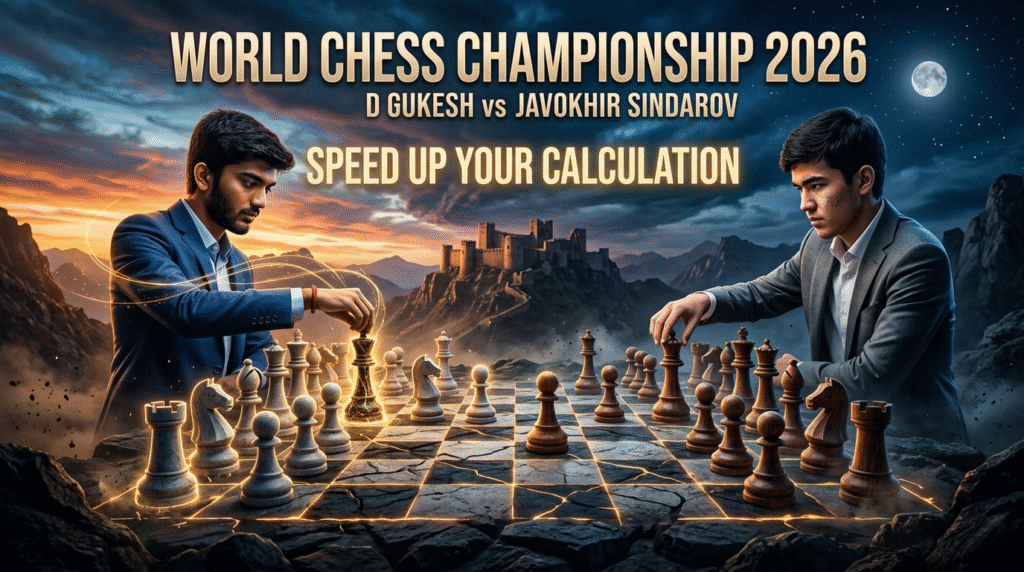
As the chess world holds its breath for the highly anticipated 2026 World Chess Championship , all eyes are now on the reigning champion, D Gukesh. The young Indian prodigy is gearing up for a fierce conflict to keep his crown, defend his title, against Uzbekistan’s rising superstar Javokhir Sindarov. Yet before this landmark battle, a well known voice from Indian chess has offered some hard strategic guidance. Grandmaster Krishnan Sasikiran has been pretty clear, he warned the champion that he needs to quicken your calculation if he wants to reliably counter that razor sharp, rapid playstyle of his upcoming Uzbek opponent . .
The Chaos Factor: Why D Gukesh Must Adapt
D Gukesh has built this pretty formidable reputation on his ability to embrace absolute chaos across 64 squares. He seems to thrive in unconventional, highly asymmetric positions that leave normal grandmasters kinda completely disoriented, and yes it’s not subtle. Still, even if this high-risk approach makes him an incredibly lethal tournament player, it also shows a clear, distinct vulnerability when you stretch it into a long, grueling match format, where every tempo matters.
As Krishnan Sasikiran put it—who famously served as a second to five time World Champion Viswanathan Anand—Gukesh’s habit of courting structural imbalances often comes with a heavy price, especially on the clock. “Sometimes Gukesh takes too much risk with his unconventional play, creating chaos and imbalance” Sasikiran remarked . “He is a champion of that kind of a game, but he often gets into time trouble.”
So, to neutralize it before the first pawn is pushed, Sasikiran firmly thinks the priority should be obvious: speed up your calculation. Just keeping pace through complex tactical tangles with only minutes , or even seconds, remaining is a dangerous routine, particularly when you face a challenger who feels most comfortable under rapid time constraints.
Evaluating the Challenger: The Threat of Javokhir Sindarov
Uzbekistan’s Javokhir Sindarov kinda earned his spot right at the championship table, by putting together a real masterclass at the 2026 Candidates Tournament in Cyprus. He moved through an elite field, totally undefeated, and still somehow managed to show profound opening preparation, plus an incredibly deep memory too. It was like everything clicked, at the right moments, again and again.
| Feature | Defending Champion: D Gukesh | Challenger: Javokhir Sindarov |
| Country | India 🇮🇳 | Uzbekistan 🇺🇿 |
| Age (2026) | 20 Years Old | 20 Years Old |
| Core Strength | Imbalance, tactical resilience, match experience | Concrete opening memory, speed, relentless momentum |
| Main Vulnerability | Recurrent time pressure in classical formats | Lack of multi-game world championship match experience |
Sindarov’s way of playing is kind of centered on real, blistering-fast calculation, like he never really stops thinking in numbers. He leans a lot on pushing his opponents into awkward positions early on, and then it’s like, they have to spend their precious time on the clock. So if D Gukesh lets himself drift into those usual deep thought patterns in the opening and the first early middlegame , then Sindarov does have the technical sharpness needed to squeeze out an advantage, in a ruthless kind of way.
Strategic Shifts Needed for the World Chess Championship
To make sure his title defense stays intact, Gukesh and his team have to put in a few sort of structural tweaks into their intense training camp, kinda like tightening the bolts, but also leaving room for feeling.
Streamlining Calculation Tree Search: Gukesh needs to learn to trust his high level intuition a bit more, instead of obsessing over every tiny branch in a disorderly position, all the way to some fully forced checkmate line.
Neutralizing the Opening Preparation: Since Sindarov has that deep memorization, Gukesh really can’t let himself get surprised. Picking solid, durable openings will keep him out of early time sinks, and out of that uncomfortable “scramble mode” feeling.
Improving Technical Endgame Conversion: In tight matches, overlooking an extra little endgame edge can be extremely punishing. Turning small pluses into full points without hemorrhaging time is basically the whole game plan.
Read more about the latest sports updates. Follow kheloexch for more!
“You don’t want to consistently find yourself in a scenario where your opponent is driving you into time trouble.” — Grandmaster Krishnan Sasikiran
Thankfully, match experience leans heavily toward the Indian superstar. D Gukesh has already been through the unusual psychological contest that comes with a full World Championship match cycle [Source: FIDE.com]. He knows how to pace both his physical focus and mental stamina over several weeks. Meanwhile, Sindarov is walking into territory that’s basically unexplored, almost completely unfamiliar.
The Psychological Edge and Growing Rivalry
There’s more tension around this match than just the technical prep stuff. Public comments from both sides seem to suggest, like it’s kind of obvious, that there is zero fondness to be found between these two 20-year-old icons. During the Grand Chess Tour’s Super Rapid & Blitz in Warsaw earlier this year, people saw a rare, super charged fist pump from Gukesh after beating Sindarov in a nasty, quick, sharp sequence.
The battle lines are pretty clearly drawn though. This isn’t only one individual duel now, it turns into a generational showdown for the top spot between two up and coming chess superpowers, India and Uzbekistan. While Sindarov arrives with raw momentum and that ice-cold self belief, forged from his undefeated Candidates run, Gukesh has the tempered staying power of a reigning king who kind of knows what it takes to guard the crown. If he can take in Sasikiran’s advice and manage to accelerate his calculation, then he should patch up his most obvious structural weak spot and still stay the better bet to keep his throne.For more news like this follow Kheloexch.
Key Takeaways
- The advice , from GM Krishnan Sasikiran, is pretty direct: D Gukesh has to speed up his calculation, otherwise he might slip into chronic time trouble while the title match is going on.
- The challenger , Uzbekistan’s Javokhir Sindarov, is hyper-prepared, and also a notably fast calculator. He basically stayed unbeaten to clinch the 2026 Candidates Tournament , so yeah his rhythm has been working.
- In the core clash, Gukesh leans toward creating complex, unconventional disorder, while Sindarov prefers to lean on deep memory plus lightning-quick execution.
- And then there’s the experience advantage: as the reigning champion , D Gukesh carries a clear, substantial lead in overall world championship match know-how.
FAQs
Why did Krishnan Sasikiran tell D Gukesh to speed up his calculation?
Sasikiran emphasized that while Gukesh is brilliant at creating complex and chaotic positions, this style frequently consumes too much time, leading to severe time trouble. Against a fast, deeply prepared player like Sindarov, chronic time pressure could prove fatal.
How did Javokhir Sindarov qualify for the 2026 World Chess Championship?
Javokhir Sindarov earned his spot as the official challenger by winning the 2026 FIDE Candidates Tournament in Cyprus, finishing ahead of an elite field without dropping a single game.
When and where will the D Gukesh vs. Javokhir Sindarov match take place?
The 2026 World Chess Championship match is provisionally scheduled to take place between November 23 and December 17, 2026. The official host city bids are currently being evaluated by FIDE.
What is the prize fund for the 2026 World Chess Championship?
The tournament features a guaranteed player prize fund of US$2.5 million, set within an overall event budget of roughly US$8.5 million.
For chess enthusiasts wanting a deeper look into how these two superstars handle intense time pressure, watching their blitz games provides excellent context. Check out this breakdown in Kheloexch where Gukesh and Sindarov clashed in an incredibly fast-paced, high-stakes over-the-board encounter that highlights exactly why calculation speed will define their upcoming world championship battle.