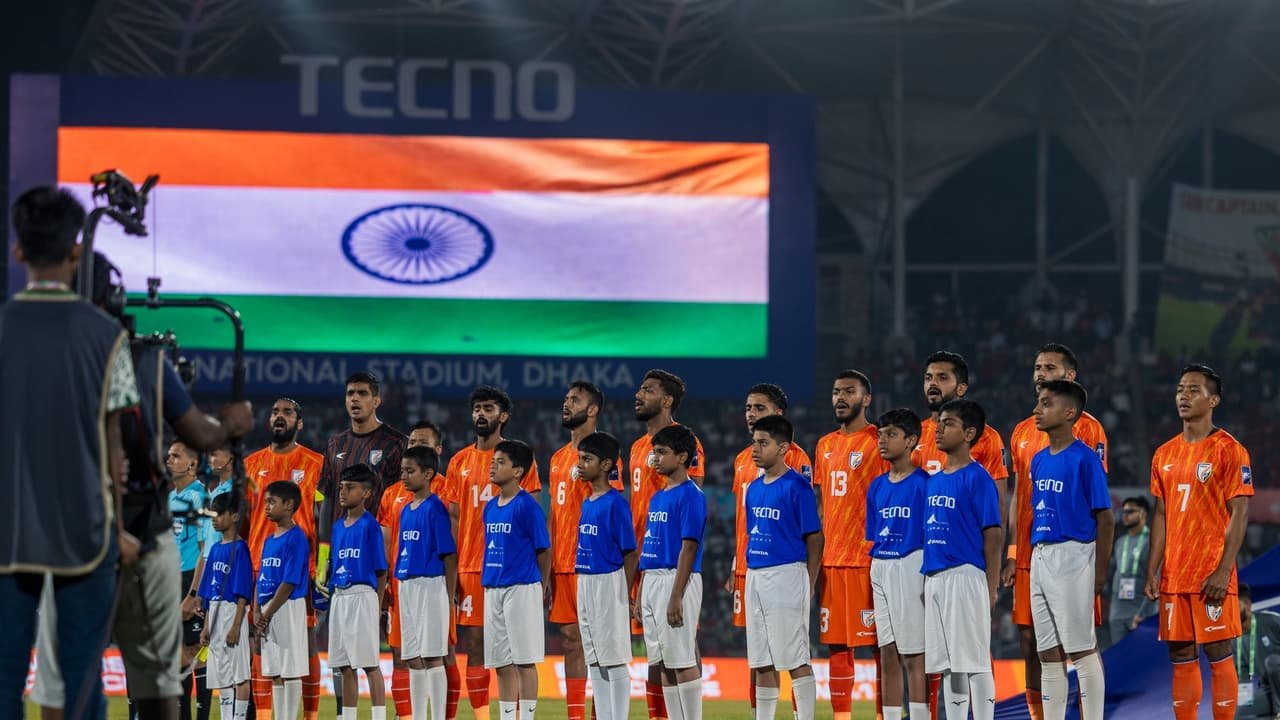
It’s almost effortless to look at a scorecard and consider that you have the complete story. The national football team was at the 2023 AFC Asian Cup, played three games, and went back home without having scored a goal. If one examines the situation closely, it looks like a team going through a bad period from beginning to end.
However, this is just a superficial problem. There are much larger issues behind the scenes than just a few bad days on the pitch. In fact, the aspiration of leaving a mark in Asia wasn’t lost in the 90 minutes of each match, but rather through the systematic long-standing problems within the team’s support. The foundation is brittle and unless the mending is done, no amount of positivity will change the outcome.
A Quick Look at the Scoreboard
The metrics of the 2023 tourney are crystal clear and tell a tale of despair. The squad was placed in Group B and their adventure turned out to be a total letdown.
The hopes were sky-high since it was the second consecutive time the squad had made it to the tournament, a first in the club’s history. However, the performance did not match the milestone. The results tell a story of being overrun.
Match 1: A 2-0 defeat to Australia.
Match 2: A 3-0 defeat to Uzbekistan.
Match 3: A 1-0 defeat to Syria.
Three matches, no goals scored by the team, and six goals conceded. The squad was ranked last in its group with no points. Even though one of those matches had a very good defensive effort in the first half, a few errors after halftime caused the loss. The showing against Uzbekistan was particularly bad, with the team not exhibiting any attacking will at all.
More Than Just a Tough Draw
Some people would consider the draw a tough one. Both the teams, Australia and Uzbekistan, were of very high quality. However, if one uses the match performances as a yardstick, one can easily see that the problems were not merely due to the quality of the rivals being so high.
Very little if any effective build-up play was observed throughout the game, and at times the defense was quite messy.
The situation has the characteristics of the “bad night” only if the excuses of poor preparation and faulty game plan are used. The team not only could not convert but also sometimes looked as if they had no strategy for doing so.
The fans’ disillusionment with the team’s performance was not limited to the score only; it was about the whole thing and the style of play the team showed. The supporters, even if through a loss, expected to see something good in the match, but the audience got to see a team that could barely execute the simplest technical moves properly.
This is not to say that the players were not trying hard at all; rather it is the whole system out of which these big matches are played that is the problem.
The Kheloexch View: A System in Need of a Fix
Despite the 2023 tournament, the issues were not over yet. The qualification for the AFC Asian Cup 2027 was another disaster with the team again not having any chance of making it.
It is then that the idea of a “broken structure” becomes impossible to ignore. The campaign was nothing but instability. The team managed to have three different coaches in the eight qualifying matches and, what is even more disappointing, they were not able to win even once.
This turnaround of leadership is a clear indication of a system in crisis. Other organizational issues have also been a major factor downplaying the progress of the team.
- There has been ongoing instability in the domestic leagues that are supposed to develop talent.
- There have been public disagreements with coaches, creating a poor environment.
- Confusion over squad selection for important tournaments has also been an issue.
- A failure to build on past successes, like the promising 1-0 result against Kuwait in November 2023, shows a lack of long-term planning.
It is labeling the team unreasonable to expect a consistently high level of performance when the system is still unstable. Not being able to qualify for the 24-team tournament is a very clear proof of these problems that have lingered for a long time.
An individual’s bad performance can be justified. Continuous underperformance, no matter the management or the season, is a sign of a weak structure.
The Kheloexch analysis suggests that the team is lacking the very foundation of their strength, which is indeed very clear.
Where Do We Go From Here?
By focusing solely on one lost match, the management is taking the simplest route possible. This, in turn, eliminates tough questions. The fact is that the national team is stuck in a cycle of mourning over the loss of the very system that was supposed to be their support.
Building a successful national football program is not only a question of time but also a matter of having a stable foundation.
It is a matter of a distinct long-term division like:
- In the end the health of the football system must be the main concern and no more the short term results.
- The players need to be nurtured through a well-established domestic league.
- The national confederation is to draw a clear and constant map for the team.
- There should be a unity of the coaching staff and tactics throughout.
- There must be continuity in the coaching staff and strategy.
- Young talent needs a clear path to the senior squad.
The vision of being one of the best in Asia is still there. However, it is going to be just a vision if the attention remains on the players who had a poor night. An entire structure needs to be redesigned with a strong future plan. Without that, the same talk will be repeated in a couple of years.